
The Brazil Africa Institute (IBRAF) conducted a survey of proposals related to the African continent and Brazilian foreign policy put forward by candidates running for the Presidency of the Republic in the 2026 elections. The government platforms of all 13 presidential candidates were analyzed, with the aim of identifying how each candidacy addresses foreign policy and, in particular, the space Africa occupies in their proposals.
The objective is to understand each candidate’s vision of Brazil’s role in the international arena, identify their priorities and goals for relations with Africa, and examine the type of partnership they propose—whether commercial, economic, diplomatic, geopolitical, South-South cooperation, among others.
In this way, the Institute seeks to contribute to a more informed public debate on the future of Brazilian foreign policy by identifying, based on the candidates’ government platforms, their respective priorities for Brazil’s international engagement.
What the Candidates Propose for Foreign Policy and Africa
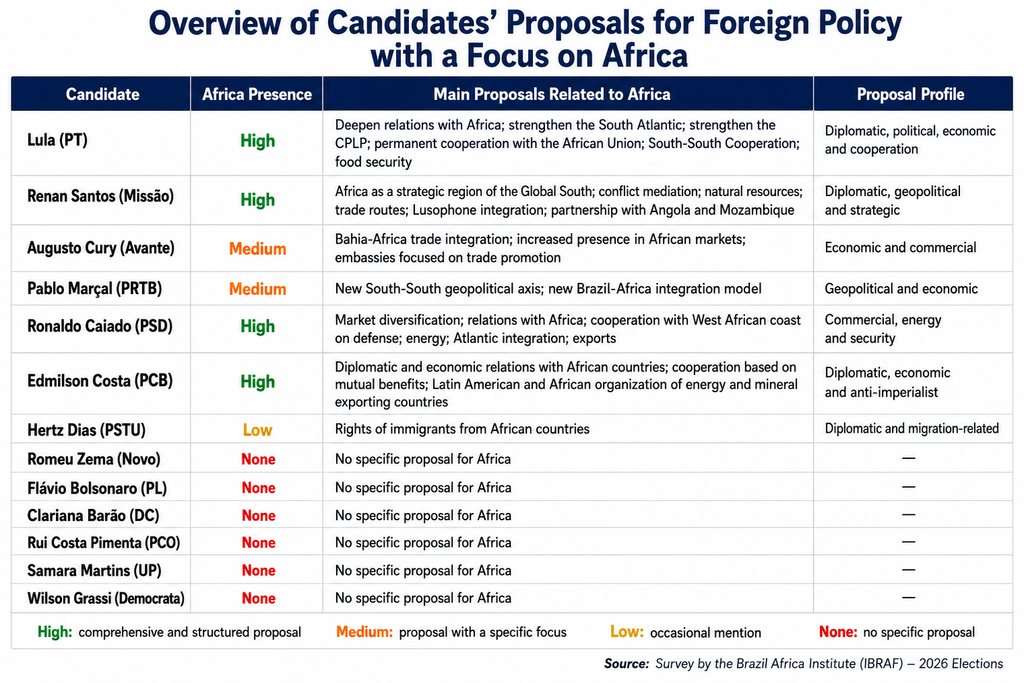
Lula (PT) explicitly proposes “deepening” relations with Africa, linking this closer engagement to the South Atlantic, the Community of Portuguese-Speaking Countries (CPLP), the African Union, and South-South Cooperation, as well as expanding technical cooperation, particularly to strengthen food security systems across the continent. Lula’s platform also calls for expanding relations with BRICS, implementing the Global Alliance Against Hunger and Poverty, and addressing the climate emergency, including the Tropical Forests Forever Facility (TFFF).
Renan Santos (Missão) identifies Africa as one of the priority regions for Brazilian diplomacy as part of his proposal to transform Brazil into a kind of “arbiter of the Global South.” His approach to the region would involve conflict mediation, natural resources, and trade routes, as well as a proposal for Lusophone integration with countries such as Angola and Mozambique.
Ronaldo Caiado (PSD) includes Africa among the regions with which Brazil should “strengthen relations,” as part of a broader strategy to diversify markets, partners, technologies, and sources of financing.
Pablo Marçal (PRTB) proposes the creation of a new South-South geopolitical axis and a new strategic model for Brazil-Africa integration, although his platform does not develop many specific measures beyond these guidelines.
Augusto Cury (Avante), in turn, focuses primarily on the commercial dimension, advocating greater Brazilian access to African markets and mechanisms for trade promotion and economic diplomacy.
Edmilson Costa (PCB) presents a perspective more focused on economic cooperation among countries of the Global South and on confronting imperialism. He proposes diplomatic and economic relations with African countries aimed at changing patterns of dependency and promoting coordination among Latin American and African countries that produce and export energy, oil, and mineral resources.
Hertz Dias (PSTU) focuses his foreign policy on the struggle against imperialism and the defense of national sovereignty. Elsewhere in his platform, however, he advocates for the regularization of immigrants from African countries residing in Brazil.
Candidates Without Specific Proposals on Africa
Flávio Bolsonaro (PL) highlights trade and negotiations “with everyone who matters to Brazil, from China to the European Union, and from the United States to Asian markets.” He also calls for strengthening relations with Argentina, the United States, and Israel. As an “urgent” priority, the platform also highlights Brazil’s accession to the Organisation for Economic Co-operation and Development (OECD), “including the gradual elimination of the IOF tax on foreign exchange, which is a mandatory condition of the process.”
Romeu Zema (Novo) prioritizes restoring Brazilian leadership in South America and strengthening relations with Mercosur countries, particularly Argentina. He also proposes Brazil’s withdrawal from BRICS and accession to the OECD, a more open migration policy, including facilitated visas for tourists from countries considered safe and legal pathways for qualified professionals, as well as reaffirming Brazil’s commitment to combating antisemitism and participating in the International Holocaust Remembrance Alliance (IHRA).
Among the other candidates who do not put forward specific proposals related to Africa, Samara Martins (UP) emphasizes internationalist solidarity, the struggle against imperialist domination, and stronger cooperation among developing countries. Rui Costa Pimenta (PCO) likewise directs his foreign policy primarily toward combating imperialism in Latin America and defending national sovereignty, while also expressing support for Cuba, Nicaragua, and Venezuela. Clariana Barão (DC) focuses her proposals mainly on security, particularly combating drug trafficking and arms trafficking through intelligence and international cooperation. Wilson Grassi (Democrata), meanwhile, presents an agenda more focused on economic issues and foreign trade.
Uneven Presence of Africa in the Proposals
When analyzing the government platforms, IBRAF found that Africa features unevenly in the candidates’ proposals. Although seven of the 13 presidential candidates make some reference to the continent, the approaches are generally not detailed and range from a more structured diplomatic and strategic engagement to predominantly commercial perspectives and occasional mentions. Another six candidates make no reference whatsoever to Africa in their foreign-policy platforms, highlighting the absence of the issue from the proposals of nearly half of the presidential candidates.
Africa features more prominently among candidates who embrace the concept of the Global South. In others, it appears merely as a market and, in a significant portion of the platforms, simply disappears from the foreign-policy agenda.
The survey indicates that Lula (PT), Renan Santos (Missão), Ronaldo Caiado (PSD), Edmilson Costa (PCB), Augusto Cury (Avante), and Pablo Marçal (PRTB) make direct references to Africa in their foreign-policy platforms, although with different levels of depth and scope. Lula, Renan, Caiado, Costa, and Marçal present proposals pointing toward a more strategic and comprehensive relationship with the continent, although Marçal’s approach is quite brief and lacks detail regarding concrete measures. Cury, in turn, treats Africa primarily as a trading partner, while Hertz Dias makes a brief reference to the continent when addressing the rights of African immigrants in Brazil.
Among the candidates who do not mention Africa in their platforms are Flávio Bolsonaro (PL), Romeu Zema (Novo), Rui Costa Pimenta (PCO), Samara Martins (UP), Clariana Barão (DC), and Wilson Grassi (Democrata). Flávio says he will establish partnerships with everyone who is of interest to Brazil and highlights strengthening relations with the United States, Argentina, and Israel. Zema advocates strengthening Mercosur, with particular emphasis on Argentina, and closer engagement with the IHRA. Costa Pimenta focuses on combating imperialism in Latin America. Samara, Clariana, and Grassi do not specifically mention any particular region.
The absence of proposals, or their superficial treatment, reveals that relations with Africa are not considered a priority by all candidates—in some cases, there are no specific proposals on the continent at all. The initiatives identified generally reinforce the importance of expanding South-South cooperation and strengthening Brazil’s international presence. Nevertheless, these formulations remain underdeveloped and do not clearly indicate how such objectives would be translated into concrete actions, targets, and public policies.
Africa’s Strategic Importance to Brazil
Africa represents a strategic space for Brazil in areas such as trade, investment, infrastructure, energy, agriculture, healthcare, education, and food security. In this context, Brazil has significant comparative advantages. One of them is its ability to adapt and transfer experiences developed under tropical conditions. Technologies and models tested and improved in Brazil—particularly in agriculture, agricultural research, healthcare, and the development of productive value chains—may find applications in different African countries, while of course taking into account the specific characteristics of each national context. This potential for the “tropicalization” of experiences constitutes an important asset of Brazilian diplomacy.
The challenge, therefore, is to ensure that relations with Africa no longer depend on political cycles and isolated initiatives. A consistent foreign policy toward the continent requires continuity, planning, and institutionalization. Countries such as China, India, Türkiye, France, and the United States have been developing, through different means and with distinct interests, long-term strategies for engagement with African countries, combining diplomacy, trade, investment, financing, cooperation, and institutional presence. For Brazil, transforming engagement with Africa into a state policy would mean going beyond diplomatic rhetoric and establishing cooperation programs with clear targets, defined priorities, monitoring mechanisms, and a long-term horizon. This is precisely one of the main elements missing from the platforms analyzed: there is recognition of the importance of South-South cooperation and Brazil’s international presence, but there is no sufficiently clear strategy translating these objectives into concrete policies for the African continent.